
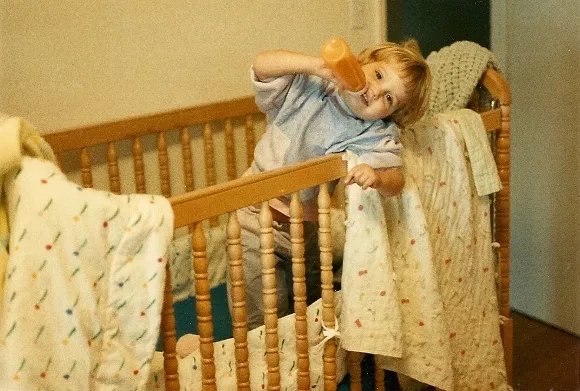
My daughter Christina discovered the art of rhetoric right around the time she was being weaned from baby bottle to plastic cup.
She would follow me into the kitchen and say solemnly, “I want milk and I don’t want it in a cup.”
Her heartrending — but unspoken — plea was, “Please, Mommy, I want my bottle.”
I’d cave in, of course, and produce the desired bottle.
How’d she do that?
Michael D.C. Drout, a professor of English at Wheaton College in Massachusetts, tells exactly what went down in that mother-daughter exchange in his Recorded Books lecture series, “A Way with Words: Writing, Rhetoric, and the Art of Persuasion.”
“A Way with Words” is one of those recorded college lecture series, and it’s a terrific resource for writers — packed with ideas for creative as well as discursive writing.
It also comes in handy when talking with your two-year-old.
Professor Drout defines rhetoric very simply as “the art of using words to change the social world.”
In his lectures he talks about the trusty five-part essay of freshman English classes – and why it’s still something to pay attention to. He also outlines how to write a classic medieval sermon, in case you’re working on one of those.
But the handiest creative writing tip from I’ve gleaned in listening to Prof. Drout is the distinction rhetoricians make between locutionary statements, illocutionary statements and perlocutionary effect.
The locutionary statement is what is actually said. “We’ve run out of granola,” I might have said to my husband Jon, who did the grocery shopping at our house.
The – unstated – illocutionary statement here was my wish that Jon buy some granola the next time he went to the supermarket.
The perlocutionary effect is something quite different. If Jon did indeed restock our granola supply by the time I was ready to pour myself another bowl, then my illocutionary statement had the persuasive effect I intended.

Being aware of these distinctions can help us navigate social situations, says Drout.
For example, let’s say a mother says to her grown son, “You’re just like your father. He never wanted to take me to the neighborhood barbecue either.” (Locutionary statement.)
The mother really means (among other things), “I want to go to the neighborhood barbecue, and I want you to take me.” (Illocutionary statement.)
How the son responds to the illocutionary statement can say a lot about his character.
Does he let his mother guilt him into taking her to the barbecue? (Which is what she seems to want.)
Does he bristle at her whiny, manipulative ways and storm out of the room? (Which is maybe what she really wants — a fight.)
Or does he perceive her whiny illocutionary statement as a sad ploy, take pity on her, and take her to the barbecue anyway? (Which may be what she truly desires in her heart of hearts.) (Perlocutionary act.)
The trick, says Drout, is to pick up on the illocutionary statements lurking behind the locutionary statements we encounter every day — in our friends, in our co-workers — in the tw0-year-old in the house.
If you enjoyed this post, you might like to read “Different From, Different Than — Which Is It?” Or, “Writer’s Block and the Toxic Reader.”
To share this story with your Facebook friends, click on the FB icon in the right column.

0 Responses
My kids had bottles until they didn’t want them anymore… somewhere around five years old! During the day they could have milk in it, and at night they had only water. Worked fine for us, didn’t ruin their teeth, and kept them feeling cozy and understood. But I had a few grouchy old ladies in the grocery store frown at me… !
Yea! And the kids turned out great.