OUR ROOTS
About the Author
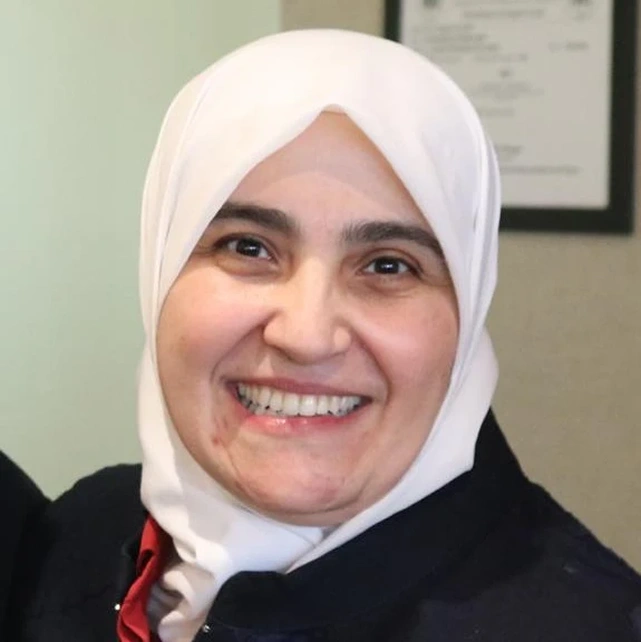
Raghad Bushnaq is the Founder and Executive Director of Mozaic, a nonprofit organization dedicated to providing comprehensive support to refugees, families, and vulnerable communities within and beyond the DC/MD/VA region. Her leadership is rooted in a lifelong commitment to service, education, and community empowerment, particularly in addressing the complex and evolving needs of displaced and marginalized populations.
With over three decades of experience as an instructor and community advocate, Raghad’s work reflects a rare integration of Islamic scholarship, humanitarian practice, and lived responsibility. Her academic journey began with the study of Islamic Education in Syria, where she learned under some of the most respected scholars of the region—teachers who authored foundational works in their respective disciplines. Under the guidance of her sheikha, her growth was nurtured intentionally and step by step, grounding her learning in discipline, ethics, and responsibility.
Beyond religious studies, Raghad pursued Agricultural Engineering in Damascus, developing a deep understanding of land, sustainability, and systems of care. Her studies later extended to Islamic Economics, equipping her with a framework that connects faith, social responsibility, and economic justice.
At the age of nineteen, Raghad left Damascus and settled in Washington, DC, where she continues to live. There, she built her life and family—raising five children and today embracing the role of grandmother to five grandchildren—while carrying with her the mist of Damascus: its values, rhythms, and spiritual foundations, sustained through a deep connection to the women who shaped her early life—her sheikha, her aunt, and above all, her mother.
Her mother nurtured in her a love for beauty, care, and intentional living, while her father fostered courage, independence, and responsibility. With his support, Raghad undertook an ambitious beekeeping project at a young age—managing over 200 hives. The project produced high-quality wildflower honey, never sold commercially, but offered as gifts to family, friends, and individuals undergoing healing, reflecting an early embodiment of service, generosity, and ethical stewardship.
Life in the United States added a formative layer to her character and leadership. Living in America sharpened her respect for time, organizational discipline, teamwork, and the effective use of technology, while also opening doors to freedom of expression, civic engagement, and advocacy that were difficult—often impossible—to access under Syria’s former dictatorship. These experiences strengthened her ability to translate values into systems, ideas into action, and compassion into sustainable community work.
These scholarly, familial, and cross-cultural experiences shaped a worldview where faith and life are inseparable, and where knowledge naturally leads to service. Through Mozaic, and through her writing and educational work, Raghad continues to advance a holistic vision that integrates Islamic values with modern professional life, innovation, and community care—without compromising foundational principles.
The Jasmine Tree emerges from this lived experience: a space where learning, worship, service, beauty, and responsibility converge—rooted in tradition and lived with purpose.
Damascus is known as the City of Jasmine.
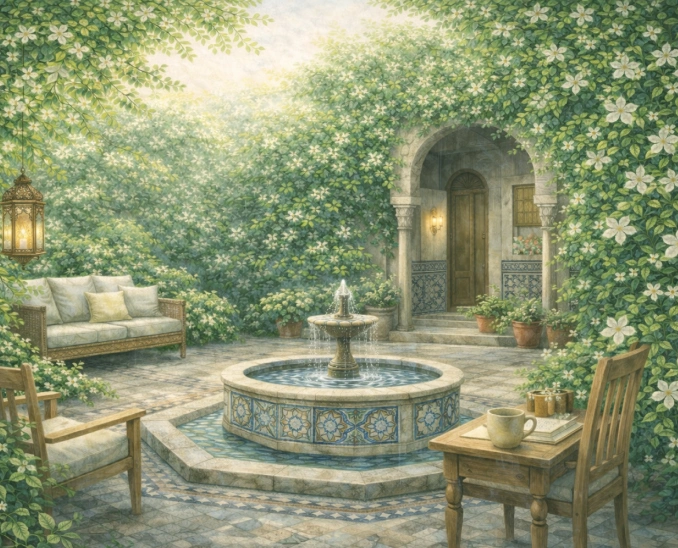
Its mornings carry a particular gentleness-the breeze of jasmine drifting through open windows, mingling with the aroma of coffee infused with cardamom. In the old Damascene home, al-bayt al-ʿarabī as Syrians call it, life unfolds inwardly. The courtyard fountain stands at the center of the house, the heart of family and social life. It gathers voices, laughter, reflection, and stillness. It teaches patience, rhythm, and belonging.
Alongside this rich way of living, Damascus has long been a city of deep religious life and Islamic knowledge. Among Allah’s greatest gifts to the city was a women-led daʿwa-quiet, rooted, and transformative. A remarkable sheikha carried a vision that brought Syrian society together by centralizing life around a divine purpose. Her work strengthened kinship, elevated family relationships, and shaped a generation of women whose ambition was to learn Islam from solid foundations while pursuing secular knowledge alongside it. Learning was never detached from life.
Faith was never isolated from responsibility. Giving back to society was a natural outcome of knowledge, not an obligation imposed from outside. These women offered their efforts entirely on a volunteer basis, seeking nothing but the acceptance of Allah. Years later, those women did not disappear-they were spread by destiny across the world. Wherever they went, they carried the amānah with them. As a trust placed upon their shoulders, they became ambassadors-teaching Islam in small towns and large cities alike. Today, the legacy of that sheikha’s work lives quietly across the globe. You may be surprised to know that even in Alaska, a student of hers continues to teach Islam and spread daʿwa.
More than sixty years of devotion-from the sheikha and her students-resulted in a living presence of her work in nearly every country, all accomplished away from fame, recognition, or credit. The intention was singular: seeking Allah’s pleasure alone.
This blog, however, is not written from a distance. It is written from the life of a Syrian woman who lived close to that sheikha—both as a student and as a relative-and who was raised by her own mother, a woman whose presence shaped everything that followed.
My mother added love and beauty to every aspect of life. She infused meaning into the ordinary-from her kitchen to her garden, from her gentle gatherings to the way she held family together. She carried warmth, generosity, and quiet strength, and she gathered an ever-growing family around her with tenderness and grace.
Through her, I lived the Damascene way of life not as a concept, but as a daily reality-one that reflected Islamic values naturally, without performance. Her home embodied the balance between faith and beauty, discipline and mercy, purpose and joy. She lived in alignment with the sheikha’s vision, and through her I learned that dīn and dunyā are not opposites, but companions meant to elevate one another.
Within The Jasmine Tree, you will find parts of that life:
Jasmine Guide
For rooted Islamic learning and trusted knowledge
Jasmine Mist
For inner life, worship, and spiritual cultivation
Jasmine & Cardamom
Where food, ritual, home, and beauty meet
Jasmine Letters
Holding memory, identity, and personal reflection
Ramadan Garden
A seasonal space for intentional worship
Jasmine Studio
Offering tangible expressions of meaning and care
This is not a blog seeking attention or authority.
It is a space shaped by inheritance, memory, and lived faith-where jasmine still blooms, even far from Damascus.
Subscribe Now Our Newsletter
Mission Statement
The Jasmine Tree exists to cultivate rooted faith, inner growth, and beautiful living through Islamic knowledge, reflective writing, and intentional practices-bringing together dīn and daily life with clarity, dignity, and care.

Vision Statement
We envision a world where Islamic knowledge is lived with depth and dignity; where individuals grow spiritually and professionally without disconnection from daily life; and where learning, worship, service, innovation, and beauty are woven together across generations and communities-without compromising faith.
Our Values

Rooted faith

Integrated living
Purposeful learning
Service & generosity
Beauty with intention

Our Approach
At The Jasmine Tree, we approach learning and growth as a lived experience, not a divided one.
We ground our work in authentic Islamic knowledge, taught with clarity, humility, and responsibility. Learning is rooted in tradition, yet attentive to the realities of modern life, professional paths, and emerging innovations-without compromising faith.
We believe growth happens through integration:
- worship alongside work
- reflection alongside action
- beauty alongside discipline
Our writing, classes, and workshops are designed to be accessible, thoughtful, and purposeful-inviting individuals to grow spiritually, intellectually, and practically, while remaining anchored in values.
We teach with care, create with intention, and serve with sincerity-trusting that meaningful change unfolds quietly, over time, like a well-tended garden.